Anyone arriving in Sardinia expecting only white beaches and clear water soon discovers another element that changes the character of the coast completely: the wind.
In South Sardinia the wind is not simply a weather condition. For kitesurfers it decides where the day happens, what the sea will do, and often the best way to experience the coast at all.
From Villasimius to Cagliari, from Chia to Porto Botte and on to Punta Trettu, the region offers very different settings. Some areas are known for relatively flat water, others for livelier conditions, others again for the landscape surrounding the rider. That variety is what makes kitesurfing in South Sardinia interesting even for people who do not practise the sport.
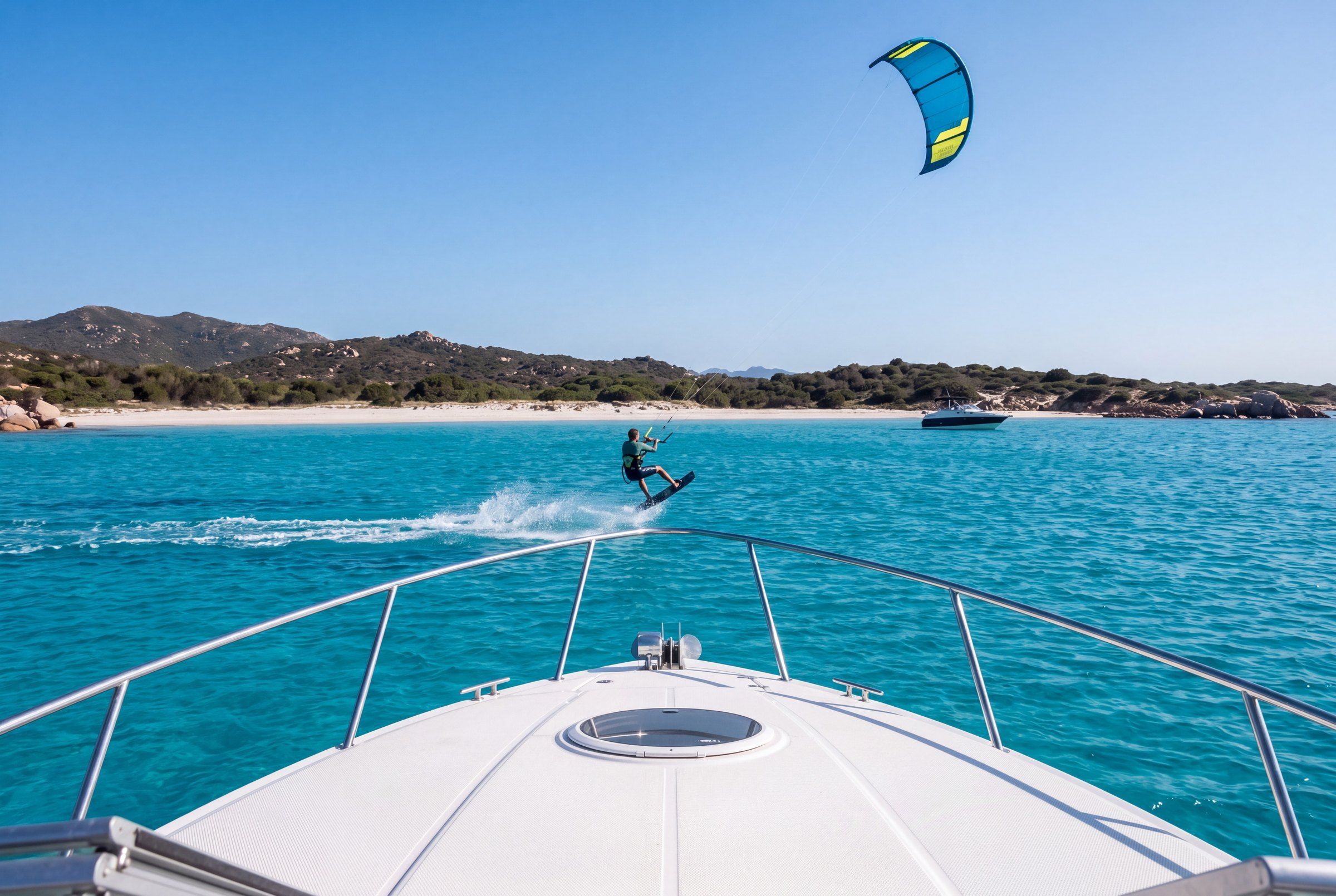
Watching coloured kites move above the water from a boat, sailing along a coast shaped by wind and reaching bays that ordinary beach trips never touch can become one of the memories of a holiday in Sardinia.
Why South Sardinia is so well known among kitesurfers
The reason is straightforward: wind, the shape of the coast, and a number of spots facing in different directions.
Two winds matter most here. The mistral arrives from the north west and the scirocco from the south east. Depending on the area, grecale, levante, libeccio and local thermal breezes play their part as well.
This means a windy day does not produce the same conditions everywhere along the coast. One spot may work beautifully in a mistral while another, tens of kilometres away, comes alive with grecale or libeccio instead. Local kitesurfing sources point to exactly this variety as a defining feature of the south of the island, listing Punta Trettu, Porto Botte, Chia, Capoterra, Poetto and Villasimius among the best known spots.
For a visitor it means finding a different Sardinia each time. The sea stops being a backdrop and becomes something to read.
Punta Trettu, one of the landmark spots
When kitesurfing in Sardinia comes up, Punta Trettu is usually the first name mentioned. It lies in the south west of the island, in the territory of San Giovanni Suergiu, not far from the Sant'Antioco area.
The shape of the place creates wide stretches of shallow, generally flat water, which is what has made it so well known among schools and enthusiasts. Local sources dedicated to the sport list mistral and scirocco among the favourable wind directions there.
Seen from above, or from the sea, Punta Trettu shows how completely kitesurfing can become part of a landscape: kites moving over a shallow mirror of water, riders leaving long wakes across the surface.
The calm of the water should not be mistaken for an absence of rules. The area has specific zones for kitesurfing and restrictions that apply to navigation as well, so it is a destination to understand and respect, particularly if you are thinking of combining kite with anything afloat.
Porto Botte, mistral country
Further along the south western side lies Porto Botte, another name familiar to anyone looking for kite spots in South Sardinia.
The bay contains distinct areas, and conditions can change noticeably even within the same stretch of coast. The mistral is the wind most associated with Porto Botte and, compared with the flat water of Punta Trettu, you can meet a livelier sea here. Local sources distinguish several zones within the spot, each with its own seabed, wind strength and direction.
It is worth knowing that a place described simply as a kite spot is rarely uniform. Wind, waves, depth and the angle of the coast change the picture entirely, and with it the level of experience a given stretch of water demands.
Chia and Su Giudeu
Moving to the southern coast, Chia is among the most recognisable landscapes in South Sardinia: beaches, dunes, headlands and water in very pale tones have made it one of the island's best known destinations.
For the kite world, Su Giudeu is the name that comes up. According to local specialist sources, easterly directions such as grecale, levante and scirocco can create favourable conditions there.
The appeal here is not only the kitesurfing. Seeing Chia from the water gives a completely different sense of the place than arriving by car and settling on one beach. From offshore the shape of the coast becomes legible, the headlands stand out, and you are not confined to a single stretch of sand.
That is why a boat trip can work for a group in which only one person kitesurfs. While one of you watches the wind and the spots, everyone else simply gets a day on the Sardinian coast.
Cagliari, Poetto and Capoterra
The gulf of Cagliari has its own place in this picture. Poetto is probably the best known beach in the city and, in the right conditions, wind sports enthusiasts use it too.
On the opposite side of the gulf lies the Capoterra area and La Maddalena Spiaggia, known in kite circles as Petrol Beach. Specialist sources point to it mainly for summer conditions linked to thermal breezes and winds from the southern quadrants.
Staying in Cagliari and discovering that a world of kites, boards, wind and open water exists a short distance from the city tends to come as a surprise.
Villasimius, Porto Giunco and Campulongu
On the south eastern side of the island, Villasimius is among the best known destinations for clear water, coves and long days afloat. Here too the wind can change the experience entirely.
Local kitesurfing sources associate Porto Giunco mainly with grecale and Campulongu with libeccio. That is worth noticing, because the two spots sit on opposite sides of the Villasimius peninsula. When the wind direction changes, so does the stretch of coast worth looking at.
From a boat this becomes a more interesting question than usual. Not which beach shall we see today, but where is the wind coming from, and which face of Villasimius will it show us.
Seeing the spots from the water
A boat lets you look at kitesurfing in South Sardinia from a completely different angle. From land you watch a rider head out to sea. From the water you take in the relationship between the kite, the wind and the whole coast.
For someone who has never tried the sport it can be startling to see how fast a kitesurfer moves and how much water a single session covers.
A boat must of course keep the required safe distance and never interfere with anyone in the water. The point of a trip like this is not to get close to the riders, but to have a privileged and safe position from which to watch both the activity and the landscape.
It is also a way to give an ordinary day at sea a second dimension: not only swimming, snorkelling and an aperitif on board, but something of the territory as well.
You do not need to kitesurf to enjoy it
A trip built around wind is not only for athletes. A couple may be drawn by the scenery. A family may want to see several bays. A photographer may be after coloured kites above the water. A group of friends may simply want something other than another day on the beach.
Kitesurfing becomes the thread running through the day rather than something everyone on board has to do. That is where a boat earns its place: it brings together sea, landscape, sailing, photography and the culture of water sports in a single day.
When to see kitesurfing in South Sardinia
No day can be guaranteed, and it is better to say so plainly. Kitesurfing depends on real conditions: the direction and strength of the wind, the state of the sea and the character of each spot.
For that reason a trip of this kind is best treated as something shaped by the day rather than a promised spectacle. We follow the sea and the wind to choose the best possible experience for the conditions in front of us, which means the route can change. Seen properly, that is part of the adventure rather than a limitation.
Mistral, scirocco, grecale and libeccio
Spend a few days in South Sardinia and you will hear about the mistral. It comes from the north west and is one of the presences that shape life on the island.
To understand this coast, though, it helps to know the others. The scirocco arrives from the south east, the grecale from the north east, the libeccio from the south west and the levante from the east.
These are old names still in daily use among sailors, fishermen, yachtsmen and kitesurfers. Knowing which direction the wind is coming from, why the sea looks different today, or why one bay is more sheltered than another turns a day out into something more than a view. You stop simply looking at the water and start reading it.
Kite and boats: what the rules say
There is an important distinction to make. Sailing along the coast and watching the areas kitesurfers use is one thing. Providing an actual support service, launching, recovering or transporting riders so that they can kitesurf, is another.
That second activity depends on authorisations and on the orders in force for the area and the season. For 2026 the Regione Sardegna issued specific seasonal rules covering tourist and recreational activities and pleasure boating on the maritime domain, and the same documents note that bathing safety falls to the local maritime authorities. The 2026 regional documents for the Cagliari area also refer to the bathing safety order of the Cagliari harbour master's office and to the order governing sport and leisure activities.
In practice this means that a trip along the coast is straightforward, while anything that directly supports a kite session needs checking against the rules that apply to that stretch of water at that time of year. If that is what you are looking for, ask before booking rather than on the day.
A different way to experience South Sardinia
What makes kitesurfing here worth knowing is not only the sport. It is the way it explains the territory. The wind decides where you sail. The coast decides how the sea forms. Every bay reacts differently. From a boat all of that becomes visible.
In a single holiday you can see the relatively flat water of Punta Trettu, the more open character of the coast at Porto Botte, the scenery off Chia, the crossing of the gulf of Cagliari or the water around Villasimius.
You do not need to know the difference between mistral and scirocco beforehand. You do not need to kitesurf. You only need to be curious about another Sardinia: the one the wind describes.
Boat trips in South Sardinia, between sea and wind
If you want to discover the coast from a different angle, a private boat trip in South Sardinia lets you leave the crowded roads behind and see bays, beaches and headlands from the water. The route is adapted to the weather and sea conditions of the day, favouring the most interesting and the safest areas.
Whether you are a kitesurfer, someone who likes photographing the coast, or simply after a few hours at sea, the point is the same: enjoying Sardinia with enough time to look at it properly.
Want to see South Sardinia from the water? Get in touch to hear about available dates for our private boat experiences. Tell us what you would like to see and we will build the day around the sea, the wind and the conditions.
Common questions about kitesurfing in South Sardinia
Where is kitesurfing practised in South Sardinia?
Among the best known spots are Punta Trettu, Porto Botte, Chia, several areas of the gulf of Cagliari and Villasimius. Which one suits depends on the wind direction, the season and the rider's level.
Is Punta Trettu good for kitesurfing?
It is particularly well known in kite circles for its shallow seabed and relatively flat water. The area does have specific zones and rules that must be respected.
Where can you kitesurf in Villasimius?
Local sources mention Porto Giunco and Campulongu. Which is usable changes with the wind direction.
Can you watch kitesurfers during a boat trip?
When the wind, the sea conditions and the route allow it, sailing along the areas riders use can give an interesting view of the sport, always respecting safe distances and the rules.
Do you have to kitesurf to join a trip built around the wind?
No. The theme works as the thread of a day devoted to the landscape, the bays and the coast, which makes it worthwhile for people who do not practise the sport at all.